
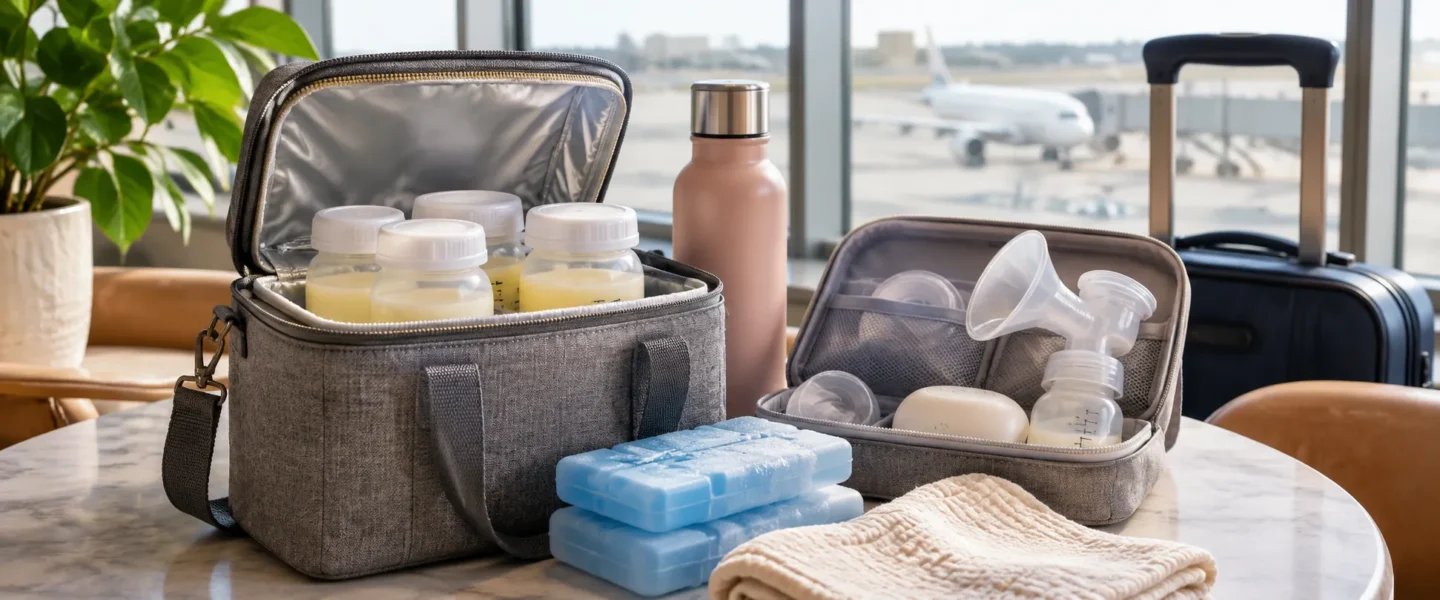
Traveling with breast milk in the United States? You can bring expressed breast milk through TSA checkpoints in your carry-on even when your baby is not traveling with you. It is exempt from the usual 3.4-ounce (100 mL) liquids limit, and TSA permits ice packs and related cooling supplies. For the journey itself, the CDC says freshly expressed milk can be carried in an insulated cooler with frozen ice packs for up to 24 hours, then used or moved to a refrigerator or freezer when you arrive. The airport-security rule and the food-safety rule are different: permission to carry milk does not mean it can be left unrefrigerated indefinitely.
This US-focused checklist separates airport screening from safe handling of expressed milk. It draws on current TSA guidance on traveling with children and the CDC’s travel recommendations for nursing mothers. Rules at airports outside the United States can differ; check the relevant authorities for international legs. These general guidelines are primarily for healthy, full-term infants; ask your baby’s clinician about different instructions for a premature or medically vulnerable baby.
TSA Rules for Breast Milk in Your Carry-On
At US airport security, breast milk and related supplies are treated as medically necessary items. That means you may carry more than 3.4 ounces (100 mL), and the milk does not need to fit into the single quart-size liquids bag for ordinary toiletries. You do not have to travel with your baby to bring milk, pumps or needed cooling accessories. TSA can screen the milk separately and may conduct additional checks.
- Tell the officer at the start: Explain that your carry-on contains expressed breast milk and cooling supplies, especially if any liquid containers exceed 3.4 ounces.
- Keep milk accessible: Be ready to remove bottles or storage containers for separate screening instead of burying them under clothes.
- Expect possible additional screening: TSA may need to inspect or test containers. Its current guidance says screening will not involve putting anything into the medically necessary liquid.
- Consider container design: TSA recommends clear, translucent bottles when feasible because some scanners may not screen flexible pouches as readily. Storage bags are not automatically prohibited.
- Know your options: If you do not want milk X-rayed or opened, notify an officer before screening. Alternative screening may take extra time.
Frozen ice packs, gel packs and other necessary cooling accessories are allowed in carry-ons, even if you are not carrying milk at that moment. Partially frozen or slushy packs may receive additional screening. Check the current TSA food and liquids policy shortly before departure; the final checkpoint decision rests with TSA officers.
Practical tip: Leave enough time for the separate inspection, keep your pump equipment together, and plan how you will keep the milk cold while the cooler is open during screening. TSA rules cover a US checkpoint, not every international connection or airline’s baggage rules.
How Long Can Breast Milk Stay in a Travel Cooler?
The CDC allows freshly expressed milk in an insulated cooler with frozen ice packs for up to 24 hours while traveling. This is not a permission to leave milk in a warm car, use melted packs with no cooling, or restart the 24-hour clock every time you transfer containers. Keep the cooler closed as much as practical. On arrival, use the milk promptly, place it in the refrigerator, or freeze it in line with its original age and storage history.
For milk that has already been frozen and is thawing, use the CDC’s thawing rules rather than treating it as newly pumped milk. The distinction matters if a long flight, delay or temperature change causes the milk to thaw completely.
| Milk condition | CDC guidance | Travel decision |
|---|---|---|
| Freshly expressed, room temperature (77°F / 25°C or cooler) | Up to 4 hours | Cool it promptly if you will not use it within that period. |
| Freshly expressed, refrigerated (40°F / 4°C) | Up to 4 days | Keep cold and count from the original expression date, not the start of the trip. |
| Freshly expressed in an insulated cooler with frozen ice packs | Up to 24 hours while traveling | Plan cold storage at your destination; don’t assume travel conditions are stable without frozen packs. |
| Previously frozen, now completely thawed in the refrigerator | Use within 24 hours of becoming completely thawed | Note when it finished thawing. Never refreeze milk after it has completely thawed. |
| Milk already warmed or brought to room temperature after storage | Use within 2 hours | Warm only the portion you expect to feed soon. |
| Leftover milk after your baby finishes a bottle | Use within 2 hours after the feeding ends | Do not put an unfinished bottle back in the cooler for a later day’s feed. |
These are different situations, not additive time allowances. If milk remains partly frozen with visible ice crystals after traveling, the CDC says it can be refrozen; if it has completely thawed, do not refreeze it. See CDC breast milk storage and preparation and its storage questions and answers.
Breast Milk Travel Packing Checklist
Pack for the full door-to-door journey, including driving to the airport, check-in, possible delays, transportation from your arrival airport, and the time until a working refrigerator or freezer is available.
- Milk containers: Clean food-grade containers or breast milk storage bags designed for the purpose, tightly sealed and clearly dated. Place them in a leak-resistant secondary bag.
- Insulated cooler: Choose a cooler that closes securely and fits your actual milk quantity; do not depend on an uninsulated tote bag.
- Frozen cooling packs: Bring enough properly frozen packs for your journey and travel conditions. They help you use the CDC cooler-storage guidance safely.
- Pump and needed accessories: Include the pump, charger or batteries, clean collection kit, spare storage containers and any compatible adapter you need.
- Cleaning plan: Bring clean replacement pump parts or determine where you can thoroughly wash and dry reusable parts during the trip.
- Arrival plan: Confirm refrigerator or freezer availability before leaving, and know what to do if the accommodation refrigerator is unavailable.
- Easy-access airport pouch: Put your essential feeding supplies where you can remove them at security without emptying the entire bag.
- Time notes: Record when each batch was pumped, chilled or fully thawed to avoid guessing the correct storage deadline.
If you plan to pump at work as well as travel, our pumping-at-work checklist covers establishing a repeatable daily routine. For washing components after the journey, use our baby bottle cleaning and sanitizing guide and the manufacturer’s specific pump-cleaning instructions.
A Practical Travel-Day Example
Example, not a new storage recommendation: A parent pumps before a morning flight and needs to carry the milk through a drive to the airport, security, a flight, and a taxi ride. Rather than planning only for the flight duration, they pack a properly insulated cooler with frozen packs and arrange access to a refrigerator at their destination. At security, they declare the breast milk and put its containers aside for the officer’s separate screening. After arrival, they put the milk away promptly and keep the original expression date on each container.
If a delay pushes the trip beyond the intended cooling plan, they reassess whether the milk stayed safely cold instead of assuming the full 24-hour guidance still applies under poor cooling conditions. For frozen milk, they check whether ice crystals remain and when any completely thawed milk finished thawing. If you cannot establish that milk was handled within safe limits, do not make a guess based on smell alone.
For ordinary feeds, you can offer expressed breast milk cold or at room temperature if your baby accepts it; the CDC says warming is not necessary. If you decide to warm a bottle, avoid microwaves and use the appropriate storage deadline afterward. Our separate warmed breast milk timing guide explains that feeding situation in more detail.
Common Questions About Traveling With Breast Milk
Can I take breast milk through TSA without my baby?
Yes. TSA permits expressed milk and associated supplies through US airport screening even if you are traveling alone. Tell the officer about milk that needs separate screening.
Does breast milk have to be in 3.4-ounce bottles?
No. The usual 3.4-ounce liquid limit does not apply to expressed breast milk under TSA’s medically necessary liquids policy. There may still be separate screening.
Can I bring frozen or gel ice packs?
Yes. TSA allows cooling accessories for breast milk in carry-on baggage, including freezer and gel packs. Partially frozen packs may require further screening.
Can I refreeze previously frozen breast milk after a flight?
Only when it remains partly frozen with ice crystals, according to CDC travel guidance. Once it has thawed completely, it should not be refrozen. For completely thawed milk kept cold, use the applicable 24-hour rule.
Can I use a warm bottle several hours later if it goes back into a cooler?
Do not use the cooler to reset the clock. CDC advises using previously stored milk within two hours after it is warmed or reaches room temperature. A partly consumed bottle has its own two-hour limit from the end of feeding.
What about international airports?
These airport rules describe TSA checkpoints in the United States. Countries, airlines, and connecting airports may have different screening rules. Check each airport’s current instructions before an international itinerary.
What to Remember Before You Leave
The easiest plan separates two questions: “Can I take it through security?” and “Will it still be safe to feed?” TSA generally permits breast milk, pumps and cooling accessories in your US carry-on, even without your baby. CDC storage guidance tells you how to keep that milk safe while traveling. Pack an insulated cooler with frozen packs, label your milk, make a cooling plan for delays, and arrange refrigeration at the destination.
Official Sources